Understand the odds and what they represent
Odds represent the probability of an outcome to happen. When you see -150, +230, or any other number with a +/- in front of it, you’re looking at numbers representing betting odds. Sportsbooks set the initial odds based on their analysis of the matchup and the anticipated result, so you can assume it is their estimated probability of a given result. It is called implied probability to stress its relation to odds. It is not the actual probability of the outcome, but I’ll get back to this in one of the next posts.
To quickly calculate the implied probability use this simple formula:

Let’s assume we are thinking about placing a bet on Bengals vs Giants and the current odds are as below:
Cincinnati Bengals -160
New York Giants +133
To calculate the implied probability of Bengals winning the game we use the above-mentioned formula like that:
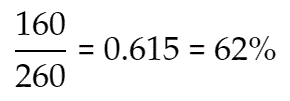
Which means there’s a 62% chance that Bengals will win the game.
Now, to calculate the implied probability of Giants winning the game we use the same formula:
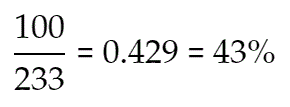
So, as per your sportsbook, there’s a 43% chance that Giants will win.
Now you say “Wait a minute, what the …, these two add up to 105%. This can not be right. I am pretty sure certainty equals 100%, not 105%!”. You are right! But, remember these are probabilities implied from your sportsbook odds, not the actual ones. They include sportsbook’s margin usually called the “juice” or the “vig”. That’s why the implied probability of the game outcome will be above 100%. In this case, the total of 105% means that the sportsbook takes 5% on every bet placed (given the money is balanced - see below).
The odds do change. After the initial odds are set, they fluctuate based on where the public’s money is going. Sportsbooks aim to adjust the odds up or down so that the money bet by the public is balanced across all options and they profit regardless of the result.
Calculate your profit
Odds presented as a negative number always relate to the favorite and represent the amount of money you need to bet in order to win $100. On the other hand, in the case of positive numbers, you’re looking at the underdog, and the value tells you how much you can win if you bet $100.

So given the previously mentioned odds:
Cincinnati Bengals -160
New York Giants +133
In order to win $100 on Bengals, you’ll need to risk $160. If you wagered $100 on Giants, you’ll win $133.
Obviously, you don’t need to risk $100, you can stake any amount you want. If you bet $50 on Cincinnati, your calculation will look like this:
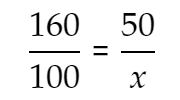
By cross-multiplying and then solving x = 5,000/160, you’ll win $31.25 (plus your original wager of $50).
If you bet $50 on Giants, your calculation would look like this:
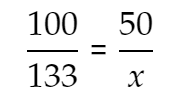
Betting $100 on Giants would get you $133, but if you only want to bet $50. Simply cross-multiply and then solve x = 6,650/100. So, if you wager $50 on Giants, you will win $66.50, and your total return would be $116.50.
Probability does not care about the past
Just one more thing before we finish here. Make sure you understand the meaning of probability. It is a measure quantifying the likelihood that an event will occur. More importantly, accept it and fully embrace it. If the match discussed above is won by Giants, even though they might have lost the previous match and Bengals won theirs by 14 points, you’re not surprised. There was a 43% chance for them to win. Same applies to coin tossing, the probability of getting tails or heads is always 50% regardless of the results of the previous tosses.
This is the first post in the ‘How to Start Profitable Sports Betting’ series. Below is a list of the remaining posts: